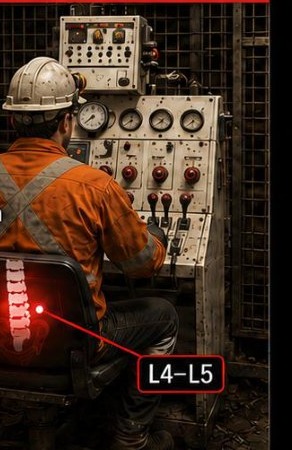
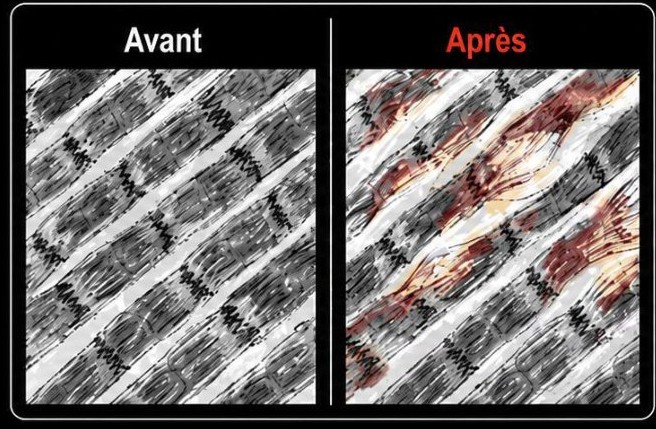
Good habits on the job
What you can put into practice starting tomorrow to protect your back, your shoulders and your joints.
Awkward positions
The further a position moves from neutral, the more strain on the shoulder, wrist and hand. Spot the angles to watch.
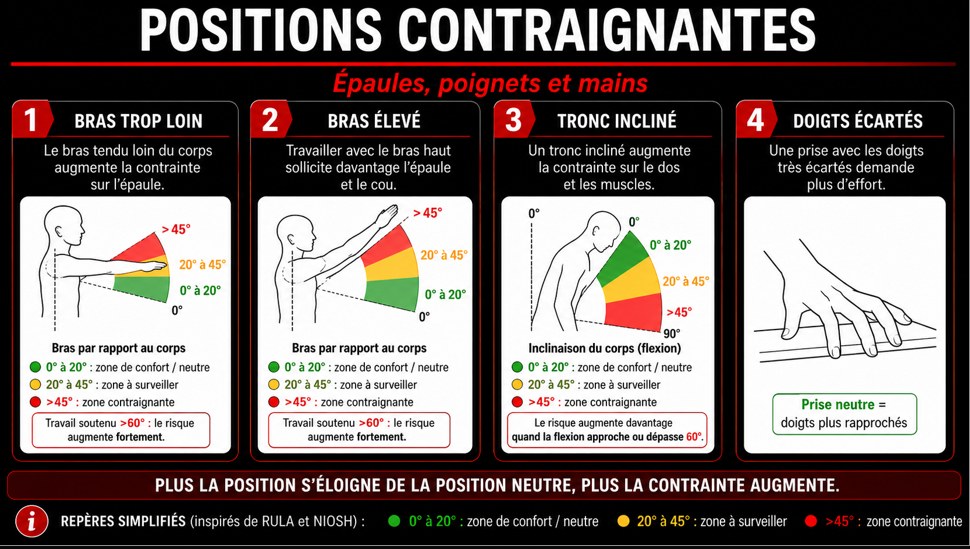 Enlarge
Comfort zones (0-20°), to watch (20-45°) and awkward (past 45°).
The 4 principles of good posture
Four simple moves to lift and work while protecting your back. We go through them one at a time.
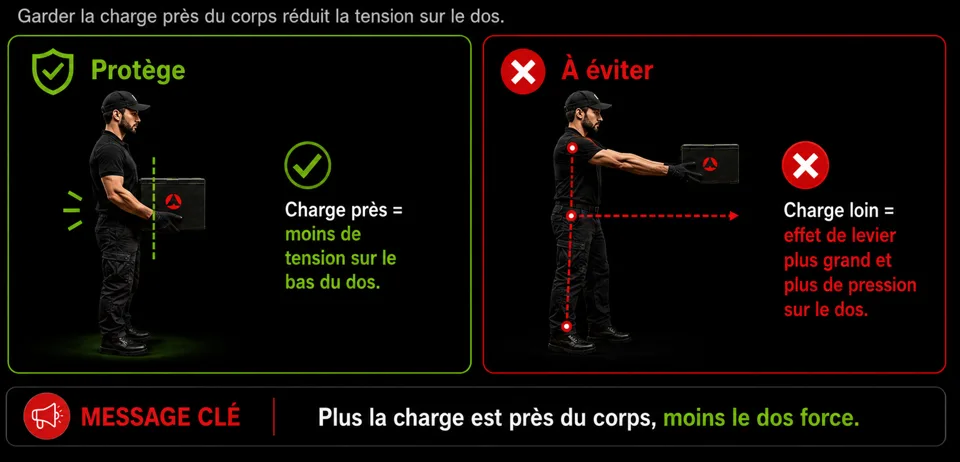
1. Load close to the body
 Enlarge
Keeping the load close to your body reduces strain on the lower back: your legs, which are stronger, do the work.
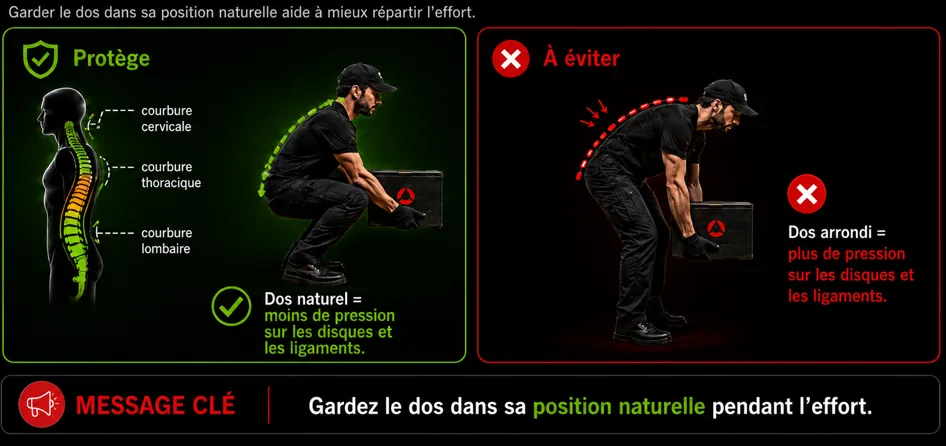
2. Back in a natural position
 Enlarge
Bend your knees and keep your back aligned, without rounding or over-arching it. The back is a support, not a lever.
Avoid twisting. Never turn your trunk while carrying a load: reposition with your feet (principle 3).
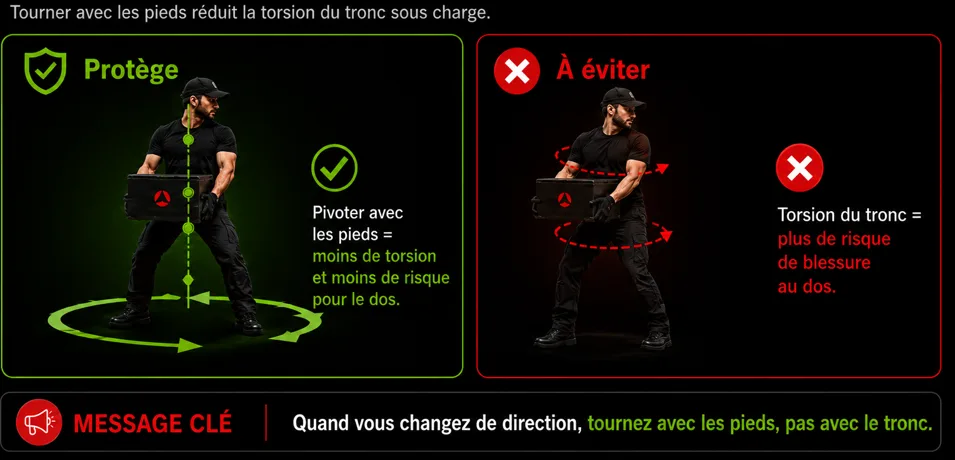
3. Pivot with your feet
 Enlarge
When you change direction, turn with your feet, not your trunk: twisting the back under load is one of the riskiest moves.
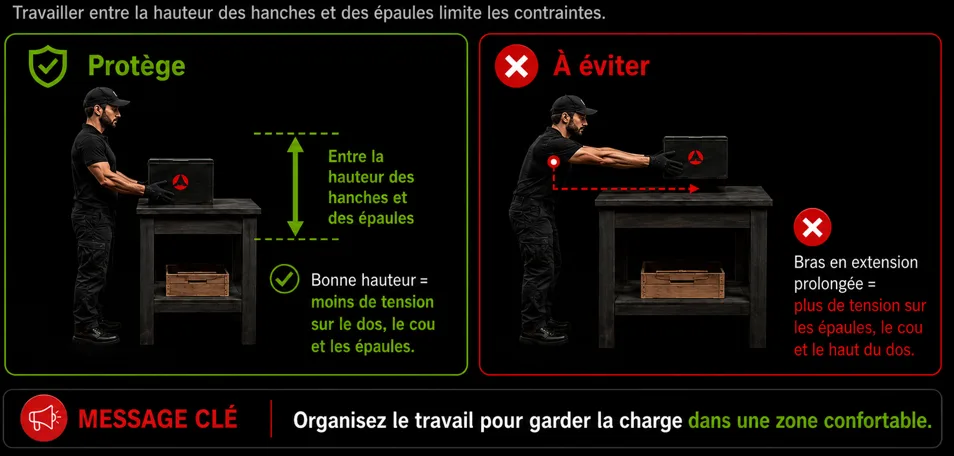
4. Work height adjusted
 Enlarge
Working between hip and shoulder height limits strain on the back, neck and shoulders.
Before your shift: get your body ready
A cold muscle gets hurt more easily. 5 minutes of warm-up beats weeks off work.
Loosen up your joints
Neck, shoulders, wrists, hips, knees: a few gentle rotations.
Wake up your back and legs
Light squats, lunges, lower-back stretches.
Build up the intensity
Start easy, let your body warm up before the heavy lifting.
Listen to the signals, report early
A discomfort that keeps coming back isn't a weakness to hide. It's information to share fast.
Why report early
- An MSD caught early heals fast
- The workstation or the task can be adjusted
- It keeps it from becoming chronic
- Your report protects your co-workers
Who to talk to
- Your immediate supervisor
- The health and safety advisor or committee
- The on-site first-aiders if needed
- Don't wait for it to get worse
The MSD prevention quiz
Ten questions to check the essentials: what an MSD is, the risk factors, fatigue, sleep and good habits. No score is saved, it's just for you.
What to remember
All of MSD prevention comes down to two pillars.
Pillar 1: Reduce the load
Good handling techniques, warm-up, micro-breaks, varying your postures and tasks, mechanical aids: asking for help isn't a weakness.
Pillar 2: Maximize recovery
Regular sleep of 7 to 9 hours, hydration, food, movement: habits that help your body repair itself.
Your body is your number-one work tool. Take care of it today so it lasts your whole career.