+
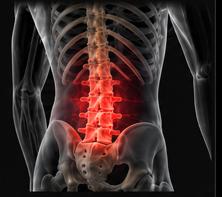
Low back pain
Pain in the lower back, the most common one.
DetailsA broken tool gets replaced. Your back, shoulders and knees have to last. Two clearly separate sections, depending on what you need:
A step-by-step path with quiz, score and certificate: perfect for new workers.
Knowledge baseAll the topics at your own pace: types of MSDs, risk factors, sleep, good habits, with interactive exploration (clickable diagram, body map, workstation simulator).
Musculoskeletal disorders are no small thing: they affect a big share of workers and weigh heavily, every year, on health and work.
Sources: CNESST, 2023 annual statistics · INSPQ
A musculoskeletal disorder (MSD) is damage to your muscles, tendons, nerves, ligaments or joints, caused or made worse by work. It's rarely the result of a single accident: it builds up gradually, when repeated movements, efforts and postures go beyond your body's ability to recover. It starts with simple discomfort and can end in a lasting injury, which is why it's so important to act early.
Pain in the lower back, the most common one.
Details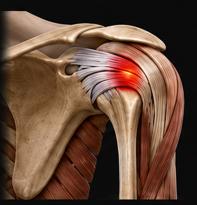
Inflammation of a tendon: shoulder, elbow, wrist.
Details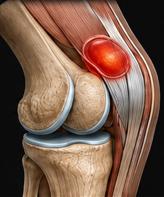
Inflammation of the bursae: knees, shoulders.
Details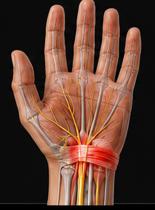
Compression of the median nerve at the wrist.
DetailsRotate the body in 3D, display the structures (muscles, bones, joints, nerves) and click an area to see the common MSDs, the factors behind them and the good habits.
Structures
Anatomical model · display the structures (muscles, bones, joints, nerves), rotate the body and click a marker to open its details. Model: Z-Anatomy (CC BY-SA).

For workers, the risk comes mainly from the task, the body and the immediate environment:
👆 Everything is clickable: the 3 families, each word inside the circles, the 10 chips around them, each one linked by a dotted line to its colour family.
An MSD doesn't have a single cause: effort, posture, repetition, fatigue and environment all add up.
Underground, several strains add up over a single shift. Check off the ones that affect your job to gauge the risk:
Result of your latest workstation assessment.
An MSD sets in by stages. The same injury goes from simple discomfort to nagging pain, then to a lasting injury. The longer the pain lasts, the longer recovery takes, which is why it matters to act right from the start.
It pulls or burns during effort, then eases off at rest. Local fatigue, stiffness at the end of the shift. This is where you need to act.
The pain comes back faster, lasts longer and sticks around even when you're not working. Your sleep and your output suffer.
The pain stays even at rest, the injury is set in: functional trouble, long and uncertain recovery.
The right time to act is as soon as the discomfort shows up (the acute phase, the green stage). The longer you wait, the more you slide toward pain and then injury. Chronic injuries are rare but have a poor outlook: past that stage, proper care becomes necessary.
Your body is your number-one work tool: this short video (2 min) shows how to maintain it day to day (sleep, physical activity, recovery) so you can better handle the demands of the job.
A few simple moves that protect your back, your shoulders and your joints, especially when you're sitting for a long stretch.
Keep the load right up against you, back in a natural position, and pivot with your feet rather than twisting your trunk.
Alternate between sitting, standing and moving. No position is good for too long, even the best one.
Stand up for a few seconds regularly: it gets your circulation going again and rehydrates the discs before they tense up.
A few targeted stretches through your shift keep your muscles loose and ease your lower back.
A cold muscle gets hurt faster: 5 minutes of loosening up beats weeks off work.
A discomfort that keeps coming back isn't a weakness to hide: caught early, an MSD gets sorted out fast. Talk to your supervisor about it.
You'll find all these habits in detail (the 4 rules, the postures to avoid, reporting) in the "Good habits at the workstation" part, further down the page.
Sitting at the controls for hours, your lower back takes it silently. Click each point to see the details.
The trunk barely moves anymore. Without changes in pressure, the disc no longer gets "pumped": water, nutrients and oxygen get in less (look back at the animated comparison in the section).
When you sit, your lower back loses its natural curve (the lumbar lordosis). The pressure spreads out poorly and loads the front of the discs more.
Compressed nonstop, the disc loses its water through your shift. Less hydrated, it absorbs the machine's shocks and vibrations less well.
The discs at the bottom of your spine, especially L4-L5, take the most pressure when you're sitting. Year after year, the wear adds up: that's disc degeneration.
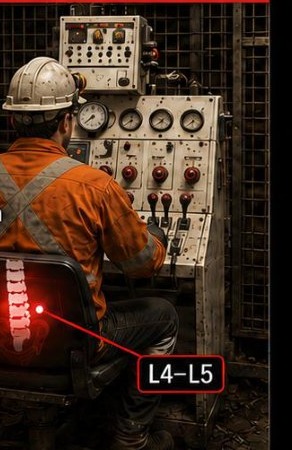
Ref.: Kastelic, Kozinc et Sarabon, 2018; Billy, Lemieux et Chow, 2014.
Repeated muscle contractions create micro-injuries in your muscle and tendon fibres. These micro-injuries trigger an inflammatory response: that's often what you feel as discomfort. At this stage, the damage is still reversible, and it all comes down to recovery time.
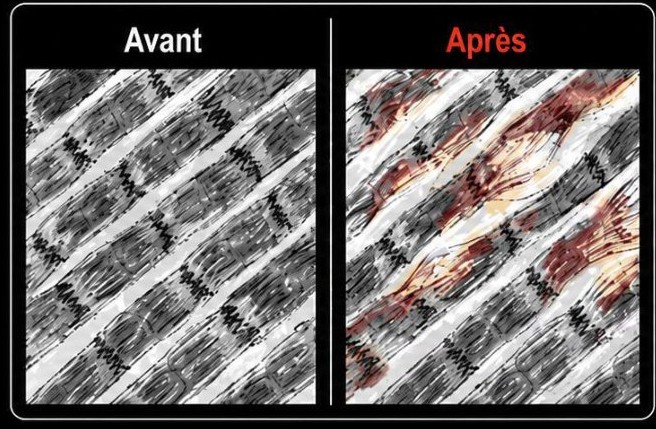
Pick a scenario:
Recovery time decides whether your tissues adapt or break down · Docking et Cook, 2019. That's why acting as soon as there's discomfort, by letting your body recover, keeps the micro-injuries from building up toward pain and then injury.
Click a level: what it means at work and what to do show up right below.
You can keep up this pace for a long time.
This exercise is for you, the worker: it helps you spot the strains of your workstation. Check off below what matches your situation — the gauge above shows a rough risk level. Checking off several families at once drives the score up faster, because the factors multiply.